-
2026-05-09

How the Income-tax Act, 2025 transforms “liable to tax” from a vulnerable interpretive gateway into a permanent structural reality — and why the crisis Tiger Global created is, by statute, temporally bounded.

I
The Crisis Tiger Global Created — and the Settlement the Income-tax Act, 2025 Has Written
The Supreme Court’s judgment in AAR v. Tiger Global International II Holdings [TS-38-SC-2026] has unsettled a corner of Indian international tax law that practitioners had, for the better part of two decades, regarded as settled. By holding that a Mauritius entity whose capital gains were not actually taxed in the residence jurisdiction (Mauritius) could not satisfy the prerequisite for treaty protection in the source jurisdiction (India) under the India–Mauritius DTAA, the Court introduced an interpretive standard that, if allowed to run without boundary, would threaten the treaty benefit claims of a very large universe of foreign investors.
The scheme of treaty protection in India — across the Income-tax Act, 1961, the Income-tax Act, 2025, and the Indian tax treaties themselves — has always been anchored in a single architectural principle. The sine qua non of treaty protection is residence-type taxability, attached to the contracting state by domicile, residence, place of management, or other criterion of a similar nature; and that gateway is satisfied even where the specific income on which source-state treaty protection is claimed is itself exempt from tax in the residence state. Participation exemptions, territorial systems, capital gains holidays, sectoral exclusions — the domestic tax policy choices of sovereign treaty partners — risk being converted, under the logic of Tiger Global, from legitimate legislative design into disqualifying circumstances that strip treaty residence from entities that are, in every other meaningful sense, genuine residents of those jurisdictions.

FIGURE · The foundational architecture: ‘liable to tax’ is the single gateway to treaty benefits, anchored in legal nexus, not actual collection.
The fallout from the Tiger Global judgment has given rise to legitimate apprehensions among stakeholders, and practitioners are right to take it seriously. Its interpretive reach, however, is temporally bounded — a point that has received insufficient attention in the commentary that has followed.

FIGURE · The Tiger Global shockwave: the actual-collection standard threatened to convert sovereign domestic policy choices into disqualifying circumstances.
The Tiger Global observations do not disturb the prevailing legal position under the Income-tax Act, 2025, which takes effect on 1 April 2026. They do not do so on two grounds. The first, narrower, ground is that the observations are in the nature of obiter dicta and therefore lack the binding force of law that Article 141 of the Constitution attaches only to the ratio decidendi of a Supreme Court decision. The second, more fundamental, ground is that the observations are no longer good in law in view of the current legal position following the insertion of a statutory definition of “liable to tax.” Section 2(29A) of the Income-tax Act, 1961, inserted by the Finance Act, 2021 with effect from assessment year 2022-23, defines the phrase, “in relation to a person and with reference to a country,” as meaning that “there is an income-tax liability on such person under the law of that country for the time being in force and shall include a person who has subsequently been exempted from such liability under the law of that country.” Section 2(66) of the Income-tax Act, 2025 carries that definition forward, and Section 159(7) makes its application a matter of statutory compulsion rather than interpretive option.
The textual point that does the architectural work is the meaning of “income-tax liability on such person under the law of that country.” The expression refers to the legal subjection of the person to the income-tax jurisdiction of that country — a status, anchored in locality — and not to a quantified actual tax payable on a particular stream of income. The inclusive limb that follows — “shall include a person who has subsequently been exempted from such liability” — places the matter beyond doubt: a person from whom no tax is in fact collected, by reason of an exemption granted by the residence state, remains within the gateway. The legislature, in other words, has chosen the status reading and has placed the actual-collection reading outside the door. After Section 159(7), it has done so compulsorily.
— — —
If one is not “liable to tax” in a contracting state, the rest of the treaty is an elegantly drafted promise that never quite materialises.
— — —
The phrase “liable to tax,” embedded in the residency article of almost every Indian tax treaty, is as understated as it is decisive. It is the gateway to treaty residence, and therefore to the entire menu of treaty benefits — exemptions, reduced rates, capital gains protection, and beyond. The interpretive choice is simple to state but profound in consequence. If “liable to tax” is read as requiring actual taxation of the specific income in the residence state, domestic exemptions and territorial features in that state risk being converted into disqualifications from treaty protection. If, instead, it is understood as a status concept — a question of whether the person is under the general income-tax framework of that state — the existence of exemptions becomes a matter of that state’s policy design, not a veto on treaty residence.
Tiger Global leaned towards the former reading, on facts that confined it to the era before the legislature had spoken; Sections 2(29A)/2(66) and 159(7) provide a stable statutory home for the latter, and they do so in a way that allows the law’s three chapters to coexist, each speaking in the time and space the Income-tax Act, 2025 has now assigned to it.
II
Before the Statute Spoke: From Azadi Bachao to Green Emirates and the Outer Edge of ‘Liable to Tax’
For decades, “liable to tax” was not defined in the Income-tax Act, 1961. Courts and administrators had to look directly to treaty text, model commentaries and general principles of international taxation. The phrase did considerable work, often without much help.
The Supreme Court in Union of India v. Azadi Bachao Andolan, dealing with the India–Mauritius DTAA, endorsed what may be described as the “general framework” or “potential to tax” understanding. It was sufficient that the person was within the charge of the Mauritius tax system; the fact that Mauritius did not levy capital gains tax on the particular gains in question did not, by itself, dislodge treaty residence. The focus was on the legal nexus to the system, not on whether a particular stream of income, in isolation, ultimately bore tax. This view aligned with the broadly shared international understanding, reflected in the OECD Model Commentary, that “liable to tax” is a status conferred by the operation of a state’s general tax law, even where that law, by design, exempts certain incomes.
What followed Azadi Bachao was a steady extension. In ADIT v. Green Emirates Shipping & Travels, the Tribunal — confronted with a UAE entity in a jurisdiction that imposed no corporate income-tax at the relevant time — held that “liable to tax” did not require actual taxability; what was required was a connecting factor of the kind that, in the language of the OECD Commentary, would attract liability if liability were to be imposed. The Indo-UAE protocol of 2007 codified that reading at the level of treaty text within two years, lending it the weight of executive endorsement. Linklaters LLP, addressing a UK limited liability partnership that was fiscally transparent in the residence state, took a similarly accommodating view; the Indo-UK protocol of 2011 followed within fifteen months. A line of decisions — ING Bewaar Maatschappij among them — extended the same logic to fund vehicles whose income-tax exposure was dispersed across underlying participants rather than concentrated in the entity itself.

FIGURE · The interpretive shift matrix: three lines of analysis — the Green Emirates outer edge, the Tiger Global actual-taxability standard, and the calibrated statutory middle.
By the time the Finance Act, 2021 came to be drafted, “liable to tax” had been read out to its useful edge. The phrase, originally drafted as a status concept anchored in nexus, had come to cover entities and arrangements whose connection to the foreign tax framework was, in some cases, more theoretical than actual. The legislature did not respond by returning the phrase to its narrowest possible reading. It did something more interesting. It found the calibrated middle. That calibration, drafted in 2021, would acquire an importance in 2026 that no one in 2021 could have foreseen.
In practical terms, the Tax Residency Certificate issued by the foreign competent authority was treated, throughout this period, as strong prima facie evidence that the person was indeed “liable to tax” in the issuing state, unless other facts suggested otherwise.
III
Tiger Global’s Turn: Actual Taxability of the Income in Question
Tiger Global arrived in a different era and on very different facts. The case concerned gains on the sale, in 2018, of Flipkart shares that had been acquired by Mauritius entities before 1 April 2017 — that is, within the window protected by the grandfathering clause inserted in the amended India–Mauritius DTAA by the 2016 Protocol. The taxpayers’ claim was that those gains were grandfathered under Article 13(3A) of the amended treaty, the protected character of the gains turning on the date of acquisition rather than on the date of sale. It was in adjudicating that grandfathering claim that the Court engaged the residence and “liable to tax” inquiry.
In analysing “liable to tax”, the Supreme Court placed emphasis on the treaty’s purpose: to avoid double taxation, not to create double non-taxation. Where the relevant gains were not taxed in Mauritius at all, the Court reasoned, there was no double taxation to relieve, and therefore no occasion for the treaty’s protective provisions to be triggered. The implication was that a person whose gains were not in fact taxed in the residence state would not satisfy the “liable to tax” condition for that income, in that factual and legal setting.
The underlying concern was not without foundation. The post-Green Emirates trajectory had stretched “liable to tax” to the point where some readings of the phrase risked emptying it of its gateway function altogether. Tiger Global responded to that concern. The instrument it reached for, however, was a more sweeping one than the legislature had — by then — already decided was needed. The Court read “liable to tax” with a closer eye on the actual tax treatment of the specific gains in the residence jurisdiction. It did so at a time when the Income-tax Act had not yet provided an express definition applicable to the transaction under scrutiny. That absence of a statutory definition was not peripheral to the outcome — it was constitutive of it.
— — —
Tiger Global is, at its core, a judgment of the definitional vacuum. Once that vacuum was filled, the conditions for its reasoning ceased to exist.
— — —
IV
What Tiger Global Did Not Decide — and Why That Matters
A clarification is necessary at this stage, because it conditions everything that follows. The Supreme Court in Tiger Global did not, and on the facts before it could not have, engaged with the statutory definition of “liable to tax.” The transactions in question concerned sales effected in 2018, on shares that had been acquired before 1 April 2017. The assessment year on appeal therefore predated AY 2022-23 by a comfortable margin. Section 2(29A) was inserted by the Finance Act, 2021 with effect from assessment year 2022-23, and was therefore not in operative force for the assessment year on appeal. The Court was construing “liable to tax” in a definitional vacuum — with only the open-textured “context” qualifier of Section 90 to draw upon. The observations on actual taxability that have caused practitioner anxiety were made in that vacuum, against that backdrop, and on a question on which the statutory definition simply had no occasion to be engaged.

FIGURE · A judgment of the definitional vacuum: what is offered as an interpretive observation in a definitional vacuum cannot retrospectively claim authority once that vacuum is filled by Parliament.
That last phrase carries the analytical weight. There is a doctrinal school — and this article adopts it, though only to the extent it is correctly framed — which holds that observations made by a court in the absence of any occasion to apply a statutory provision do not, and cannot, become binding precedent on the meaning of that provision when it later falls for application. The principle is not that obiter is always non-binding; it is the narrower and more secure proposition that observations made in a definitional vacuum cannot, when the vacuum is subsequently filled by statute, retrospectively claim authority over the statutory text. To do otherwise would be to treat a court as having decided what it never had the occasion to decide. That is not how the doctrine of precedent operates, and it is not how statutory interpretation operates.
The implication is structural and, in this case, decisive. This article does not argue that the Supreme Court misread Section 2(29A) or Section 2(66). It could not have, because neither provision was before it for the transaction in question. The argument is architecturally different and, on the question at hand, more conclusive: the interpretive space the Court was constrained to occupy — a space in which “liable to tax” was statutorily undefined, and the residual “context” qualifier of Section 90 was the only available interpretive resource — has now been legislatively closed. For transactions from AY 2022-23 onwards, Section 2(29A) supplies the definition the Court did not have. For transactions from 1 April 2026, the Income-tax Act, 2025 completes the architecture: Section 2(66) carries the definition forward, and Section 159(7) makes its application a matter of statutory compulsion rather than interpretive option.
The Court’s silence on the statutory definition is therefore not a gap in this analysis; it is its precondition. What was an interpretive observation offered in a definitional vacuum cannot survive a definition that Parliament has now placed mandatorily at the centre of the interpretive inquiry. Tiger Global retains its full force on what it did decide — the validity of the Tax Residency Certificate, the question of beneficial ownership, and the application of grandfathering under the amended India–Mauritius DTAA. What it did not decide — what statutory “liable to tax” means once Parliament has spoken, and once Parliament’s voice carries the compulsive force conferred by Section 159(7) — is the question to which the rest of this article is addressed.
V
Section 2(29A): The Calibrated Middle, Quietly Drawn
The Finance Act, 2021 marked a quiet yet important development by inserting Section 2(29A) into the 1961 Act with effect from assessment year 2022-23. For the first time, “liable to tax” acquired a clear domestic statutory meaning.
Section 2(29A) proceeds in two steps. First, it requires that there be an income-tax liability on the person under the law of the foreign country — preserving the fundamental idea that “liable to tax” reflects being under that country’s general income-tax jurisdiction. Second, and crucially, it states that the term shall include a person “who has subsequently been exempted from such liability.”

FIGURE · The calibrated middle: Section 2(29A)’s twin limbs — a textual anchor preserving nexus, and an open door defeating the actual-collection requirement.
The architecture is what makes the provision interesting. The first limb provides a textual anchor: an income-tax liability framework must exist. The second limb opens the door wide: exemption from that liability does not defeat the status of being “liable to tax.” Read together, the two limbs locate the phrase in a precisely identifiable middle position. They accept the core of the Azadi Bachao and Green Emirates philosophy — that “liable to tax” speaks to nexus rather than to actual collection. They simultaneously acknowledge the underlying concern that the post-Green Emirates trajectory had pushed the phrase past its useful elasticity. They calibrate. They do not restrict, and they do not cut loose. They draw a line, and they draw it through what most thoughtful commentators on either side of the question would, in a quiet moment, have conceded was the right place.
At this stage, however, Section 2(29A) coexisted with the pre-existing treaty-implementation regime under Section 90 of the 1961 Act and Article 3(2) of the treaties. Undefined treaty terms were still interpreted as per domestic law “unless the context otherwise requires.” The statutory definition was strong, but the “context” caveat remained, at least in theory, a point of interpretive flexibility. It is this caveat — the last residual space in which the older interpretive register could survive — that the Income-tax Act, 2025, with effect from 1 April 2026, has now systematically removed.
VI
The Calibrated Middle — and the Remedy That Outpaced the Disease
When Section 2(29A) was introduced in 2021, the professional reaction was naturally cautious. In a world preoccupied with BEPS and double non-taxation, any definitional intervention around “liable to tax” attracted suspicion. It was easy to imagine that the legislature was moving towards a narrower, more revenue-protective understanding of the phrase. The professional consensus, such as it was, treated Section 2(29A) as a step towards greater scrutiny of treaty benefit claims, not towards their protection.
That consensus was not unreasonable given the times. What it failed to reckon with was that the legislature was not chasing the Green Emirates line back into a corner. It was finding the middle. Section 2(29A) accepted the core of the Azadi Bachao and Green Emirates philosophy and added a textual anchor. It thus did three things at once. It preserved the nexus principle. It calmed the perception that the post-Green Emirates drift had pushed the phrase past its useful boundaries. And it gave domestic statutory clothing to a concept that, until then, had lived on judicial scaffolding alone.
What was not anticipated in 2021 — and could not have been — was that the Supreme Court, in 2026, would arrive at the same underlying concern through a different route and through a different lens. Tiger Global, decided in the definitional vacuum that Section IV has described, was animated by precisely the worry that had moved the legislature five years earlier: that “liable to tax” should not become an empty phrase, and that the treaty network should not be read as endorsing arrangements where no tax is paid anywhere. The diagnosis was shared. The prescription parted ways.
— — —
The provision feared in 2021 as the instrument of restriction turned out to be the instrument of measure.
— — —
There is, in retrospect, a pleasing symmetry. The interpretive standard that emerged in 2026, animated by the same concern, turned out to be the instrument the legislature had, by then, already declined to enact. The difference is not a difference of motivation. It is a difference of dosage. The legislature, working with the benefit of deliberation, found a calibration that left the gateway open while shutting the door against its abuse. The Court, working in a definitional vacuum that no longer exists, reached for a remedy that — for the period beyond its own facts — would have closed more of the door than the disease called for.
The judicial remedy was well beyond what the disease needed. The disease was real: post-Green Emirates, “liable to tax” had been stretched in ways that put pressure on its core architectural function. The cure could have been, and from 2021 already was, the calibrated middle that Section 2(29A) drew. The actual-taxability standard, applied beyond the period the Court was confronted with, would have done more than the calibration required and more than the disease invited. The legislature, perhaps surprisingly to those watching the political weather of 2021, had drawn the more calibrated line.
This sequence carries a lesson that goes beyond its immediate practical significance. Statutory text, once enacted, acquires a life independent of the political moment that produced it. It operates across time and across factual contexts that no draftsman could entirely foresee. Section 2(29A) was drafted in a legal universe where Green Emirates and Azadi Bachao still held the field; it proved decisive in a legal universe created by a Supreme Court judgment that arrived five years later. The provision was read in 2021 through one set of anxieties; it is read in 2026 as the architectural anchor against an interpretive standard its authors could not have anticipated. Its text did not change. The world around it did. And in that change lies the entire story of how a calibrated middle, drafted to settle the Green Emirates drift, became the structural answer to a different and unexpected problem — until the Income-tax Act, 2025, with effect from 1 April 2026, arrived to make that answer permanent and compulsory.
In revenue law, we often see exemptions that are narrow in text but generous in effect. Section 2(29A) is the rare case where the generosity is in the calibration itself — drafted by a legislature that may not have known quite how generous, or how durable, it was being.
VII
Section 159(7) of the Income-tax Act, 2025: From Contextual Flexibility to Ordered Supremacy
The Income-tax Act, 2025 recasts the treaty-implementation rule in Section 159. Sub-section (7) is where the architecture truly shifts — and where the new regime delivers its most consequential answer.
Under the 1961 Act, the bridge between treaties and domestic law was Article 3(2). Undefined treaty terms took their meaning from domestic law “unless the context otherwise requires.” Domestic definitions were important, but they always shared the stage with “context” as a potentially competing performer. This is the environment in which the older interpretive register could flourish, and in which Section 2(29A) operated between 1 April 2022 and 31 March 2026.

FIGURE · From transition to permanence: under Article 3(2), the domestic definition was a competing performer; under Section 159(7), it is the mandated obligatory meaning.
Section 159(7) introduces a different, explicitly sequenced model. It provides that, in interpreting terms used in tax agreements, the following hierarchy applies: if the term is defined in the agreement itself, that definition governs; if the agreement does not define the term, the meaning assigned to it in the Income-tax Act, 2025 applies; and only thereafter is any residual context considered, and only for matters not already resolved by the first two steps.
The crucial refinement is that, once the interpreter reaches the second step, the familiar “unless the context otherwise requires” caveat no longer stands between the Act’s definition and its application. The definition in the Income-tax Act, 2025 is no longer one contender among several; it is the mandated meaning for that term in the absence of a treaty definition. Context has been deliberately moved from the front row to the residual space. Application of the statutory definition is no longer an interpretive option — it is a statutory compulsion.

FIGURE · The permanent settlement: Section 2(66) carries the inclusive definition forward; Section 159(7) replaces the Article 3(2) pathway with ordered supremacy.
For “liable to tax,” the implications are clear and complete: the 2025 Act carries forward the Section 2(29A) concept as Section 2(66), including the express inclusion of a person who has “subsequently been exempted from such liability.” Where a DTAA does not contain its own definition of “liable to tax” as a phrase — which is the position under the vast majority of Indian treaties — Section 159(7) directs the interpreter to apply Section 2(66). There is no longer an internal, treaty-level invitation to ask whether “context” requires a different meaning of that particular expression. The new regime has closed that door with statutory finality.
VIII
Article 3(2) and the Two Phases of Coexistence Under the Income-tax Acts of 1961 and 2025
This allows us to see the period from 1 April 2022 onwards as comprising two distinct, but coherent, phases in the life of “liable to tax” — the first governed by the 1961 Act, the second by the Income-tax Act, 2025 with effect from 1 April 2026.
In the first phase, running from 1 April 2022 to 31 March 2026, Section 2(29A) defined “liable to tax” in domestic law. Treaty interpretation still moved through Article 3(2), which incorporated domestic meanings “unless the context otherwise requires.” There was, therefore, a genuine dialogue: the statute made a clear statement that exemption does not defeat liability; Article 3(2) allowed context — such as concerns about double non-taxation — to be considered in interpreting treaty terms. In this phase, Tiger Global and Section 2(29A) coexisted. The judgment spoke to the meaning of “liable to tax” for its own pre-definition facts and, at the level of principle, provided one possible contextual lens for the post-definition period. Section 2(29A) simultaneously offered a strong textual anchor for a nexus-based reading when applying treaties via Article 3(2). The coexistence was imperfect, as all transitional coexistences are, but it was structured and manageable.

FIGURE · Three eras of coexistence: each chapter of the law speaks to its own period; together, they form a temporally bounded, structurally coherent settlement.
In the second phase, operative from 1 April 2026, Section 2(66) restates the definition, and Section 159(7) replaces the Article 3(2) pathway with a different bridge. The hierarchy is explicit: treaty definition, then the Income-tax Act, 2025 definition, then context. The “unless the context otherwise requires” caveat no longer mediates the application of the Act’s definition. For treaties that do not define “liable to tax,” Sections 2(66) and 159(7) now make the domestic definition the obligatory meaning. Coexistence becomes calmer and, indeed, structurally assured. Tiger Global remains fully relevant for its own period and for the issues it actually decided. But for post-2026 transactions under treaties that leave the phrase to domestic law, the new regime has placed the statutory definition in a position of settled and unambiguous primacy.
Across both phases, the story is one of evolving structure, not of conflict. Before 2022, courts were necessarily creative in the definitional vacuum; between 2022 and 2026, they had a statutory definition and an open-textured bridge; after 2026, they have the same definition and a structured, sequenced bridge from which the contextual escape route has been removed. The crisis is real, but it is temporally bounded — and the Income-tax Act, 2025, in force from 1 April 2026, is the instrument of that boundary.
IX
When the Treaty Text Speaks: Interplay with Sections 2(66) and 159(7)
Section 159(7) of the Income-tax Act, 2025 begins, properly, with the treaty itself. If a DTAA or its protocol defines “liable to tax,” or if it contains detailed provisions dealing with entities enjoying special regimes — through Limitation on Benefits clauses, Principal Purpose Tests, or tailored residence rules — that treaty language continues to be determinative. In such cases, Sections 2(66) and 159(7) play a complementary, not overriding, role. They fill gaps rather than redraw treaty boundaries.

FIGURE · The treaty implementation decision tree: treaty definition first; then the Section 2(66) meaning, mandatorily; only then, residual context — for matters not already resolved.
It is in the large universe of treaties that do not define “liable to tax” that Section 2(66) comes into its own. For these, the statutory definition functions as an agreed back-office meaning, ensuring that the parties know what India will understand by that phrase when the treaty directs them to refer to domestic law. The foreign state, for its part, continues to apply its own domestic understanding, which — in most of India’s key treaty relationships — also focuses on nexus to the tax system rather than the taxation of each income stream in isolation. The new regime thus aligns India’s domestic interpretive position with the shared understanding that most treaty partners have always maintained.
The treaty continues to govern its own substantive provisions; what Section 159(7) settles is the meaning to be given to the gateway phrase, not the substantive distributive allocations that the treaty’s own articles continue to determine. That distinction — between the gateway and the distributive content — is the architectural insight that the next section harvests in detail.
X
The Natural Corollaries — and the Inverse Inference That Cannot Be Drawn
The architecture sketched in the preceding sections is not merely descriptive. It is generative. Once the application of Section 2(66) becomes statutory compulsion rather than interpretive option, certain consequences follow with the obligatory force of statutory text — and one tempting inverse inference is structurally barred.

FIGURE · Relocating the double non-taxation debate: the rationale is not diminished but structurally displaced from the residence gateway to the anti-abuse boundary, where it can operate transparently.
Five corollaries follow.
First, exemption is not disqualification at the gateway. This is no longer a judicial gloss, an OECD Commentary view, or a treaty-purpose argument. It is statutory text. A taxpayer-resident in a contracting state whose income is exempted from tax in that state — entirely, partially, by category, by sector, by holiday, by holding-period, by participation rule, or by territorial design — remains “liable to tax” in that state for purposes of the residence article of the treaty. The proposition holds with the force that Section 159(7) confers upon the Income-tax Act, 2025’s definitions where the treaty is silent.
Second, the double non-taxation rationale is structurally displaced from the residence inquiry. The purposive reasoning that treaties exist to relieve double taxation, not to create double non-taxation, was deployed in the older register at the gateway level, to deny treaty residence itself. After Section 2(66) read with Section 159(7), that rationale can no longer operate at that level for current transactions. Whatever residual force it retains must be redirected to the distributive articles, or to the anti-abuse architecture — the Principal Purpose Test, the General Anti-Avoidance Rule, and Limitation on Benefits provisions where applicable. This is not a diminution of the rationale; it is a relocation of it to the structural layer where it can operate transparently and on its own terms, which is also where, on a principled reading of the treaty network, it has always belonged.
Third, the layered architecture of treaty access becomes operationally clean. The residence gateway is governed by Section 2(66) where the treaty does not define the term; the substantive distributive entitlement is governed by the treaty’s own articles — capital gains under the capital gains article, dividends under the dividend article, business profits under the business profits article, and so on; and the anti-abuse layer is governed by its own dedicated provisions. Each layer retains its proper role and its proper analytical machinery. The new regime has not collapsed these layers — it has separated them with greater clarity than the law has hitherto enjoyed.

FIGURE · The layered sovereignty diagram: the gateway, the substantive rooms, and the anti-abuse boundary wall — three layers, three analytical machineries, one architecture.
Fourth, the sovereign tax-policy choices of India’s treaty partners are vindicated. Participation exemptions, territorial systems, capital gains holidays, sectoral exclusions, special economic zone regimes — these are policy designs of sovereign legislatures, and their existence cannot, after Section 2(66), be converted into disqualifying circumstances at the gateway level under Indian law. The longstanding international consensus on this question is now domestically anchored, and anchored in a provision whose application is mandatory rather than optional.
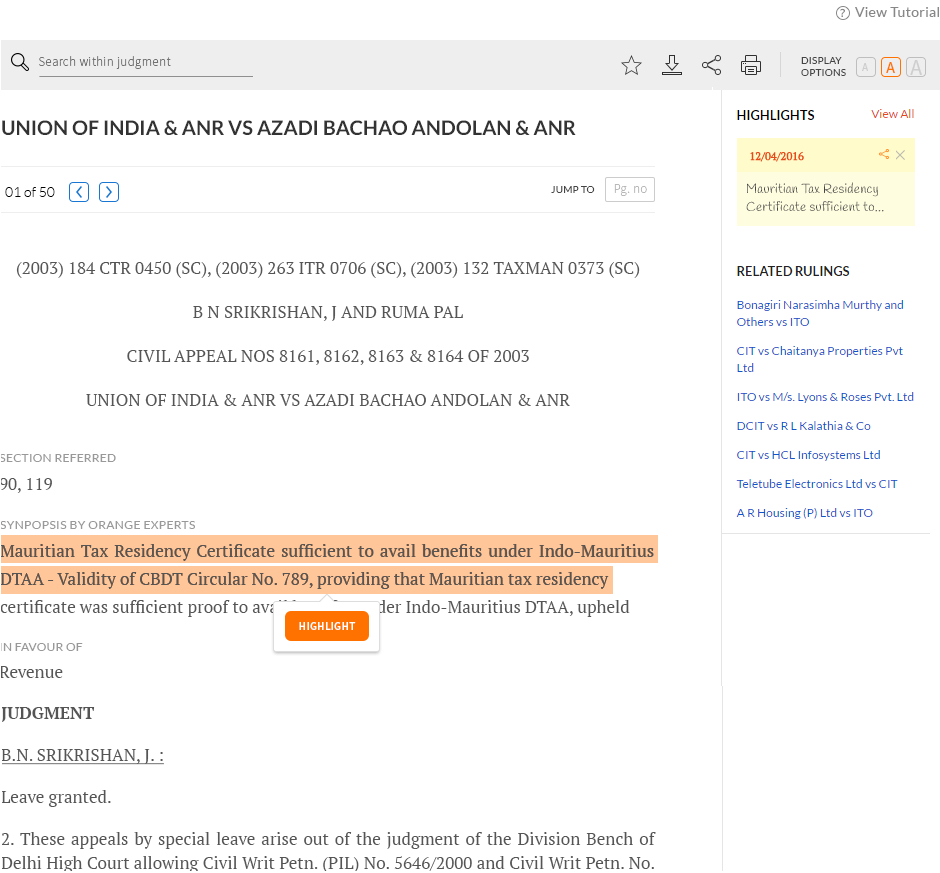
Fifth, the Tax Residency Certificate retains and acquires renewed evidentiary weight. A TRC issued by the foreign competent authority has long been treated, under CBDT Circular No. 789 and a settled body of jurisprudence, as the foundational evidence of residence in the issuing state. The most common back-door challenge to a TRC’s force — that the income was not actually taxed in the issuing state, and that the certified resident is therefore not “liable to tax” — is now foreclosed at the residence gateway by the express terms of Section 2(66). The TRC’s centrality is not merely preserved but doctrinally reinforced.

FIGURE · The anatomy of a treaty claim: five corollaries — exemption is not disqualification, the debate is relocated, the layers are clean, sovereignty is vindicated, the TRC is supreme.
Against these natural entailments stands a tempting inverse inference that must be addressed and rejected. It might be argued — and one can anticipate that it will be — that the very specificity of Section 2(66)’s inclusive limb implies that exempted income is, by negative inference, denied treaty protection. The argument is structurally unsound for three reasons.
First, Section 2(66) is a positively inclusive enactment, and a canon of construction does not permit such an enactment to be read as exclusive of what it does not address. Parliament’s affirmative inclusion of the “subsequently exempted” person at the residence gateway cannot be inverted into a negative implication denying treaty protection to exempted income at any other layer. The text was drafted to do one thing; it cannot be made, by inference, to do another.
Second, the inverse inference confuses the layers. Section 2(66) operates at the residence gateway. Whether a particular item of income is protected by a treaty turns on the relevant distributive article and, where applicable, the anti-abuse architecture. An argument addressed to the treatment of exempted income is an argument that belongs in the distributive layer or the anti-abuse layer; it cannot be smuggled into the residence layer by the inverse reading of a provision that, by its terms, addresses the residence question alone.
Third, the inverse inference would defeat the very legislative purpose that Section 159(7) was structurally designed to secure. Section 159(7) eliminates the “context” escape route at the level of the residence definition precisely to ensure interpretive stability. To read into Section 2(66) a hidden disqualification of exempted income would reintroduce, at the level of substance, the interpretive instability that the architecture was drafted to remove — and would convert a provision Parliament enacted to protect into a provision that, by implication, denies. Statutory inclusion does not operate by such inversions.
The corollaries are therefore best understood through a single formulation. Section 2(66) settles the residence question and clears the gateway. It neither resolves nor pre-empts the substantive distributive entitlement, which the treaty continues to govern. It neither immunises against, nor enables, anti-abuse scrutiny, which the dedicated machinery continues to govern. The legislative concession is a concession at the gate — emphatic, mandatory, and beyond contextual displacement after Section 159(7) — but a concession at the gate alone. Inside the treaty, the treaty governs. At the boundary of abuse, the anti-abuse provisions govern. The architecture is not flat; it is layered, and the layers retain their proper analytical sovereignty.
XI
A Clinical Takeaway: The Permanent Statutory Address
Seen in sequence, the journey of “liable to tax” in Indian treaty law is a story of progressive statutory settlement, with the Income-tax Act, 2025, operative from 1 April 2026, as its final and authoritative chapter.
The phrase began life as an undefined treaty concept. Azadi Bachao Andolan anchored it in nexus. The Green Emirates line stretched it to its outer edge. Section 2(29A) of the 1961 Act, drafted in 2021 against that backdrop, drew the calibrated middle. Tiger Global, decided in the definitional vacuum the Court was constrained to occupy, addressed the same underlying concern but through a more sweeping instrument than the legislature had thought necessary. And the Income-tax Act, 2025 has now placed the calibration permanently and compulsorily at the centre of the inquiry, through Sections 2(66) and 159(7).
The phrase has not changed its core task: it continues to answer the question — is this person under the income-tax jurisdiction of the other contracting state? What has changed, decisively, is the map that the new regime provides for finding that answer: a sequenced, hierarchy-driven map, no longer optional in its application but compulsory in its force, and from which the contextual detours that the older register permitted are no longer available as a matter of law.